If you are citizen of an European Union member nation, you may not use this service unless you are at least 16 years old.
You already know Dokkio is an AI-powered assistant to organize & manage your digital files & messages. Very soon, Dokkio will support Outlook as well as One Drive. Check it out today!
Sumi-e is the Japanese art of painting using only black ink. It was originally started in China and known as shui-mo hua (which is why the Japanese sometimes also call the art suiboku-ga). In China, it evolved from earlier forms of wash painting. Through time, Korean Zen Buddhist monks picked up the art and later introduced it to Japan during missionary visits. By the mid fourteenth century the art had a firm niche in Japanese culture. The period running from 1338-1573 has become known as the Muromachi Period. This time not only saw the introduction of sumi-e to Japan, but was also the point during which this art style was at its most fashionable.
Philosophy
Because of its Zen nature, sumi-e painting is not only an art, but also a discipline. Much like how a tea ceremony involves an amount of focus and mindfulness of action, so too does the entire process of creating a sumi-e painting. Every action, from the mixing of ink to the placement of each individual stroke requires the artist to concentrate on the "here and now" of the action. Even the finished painting embodies this philosophy. The goal of this form of ink wash painting is not to capture the likeness of the subject, but instead to capture its essence.
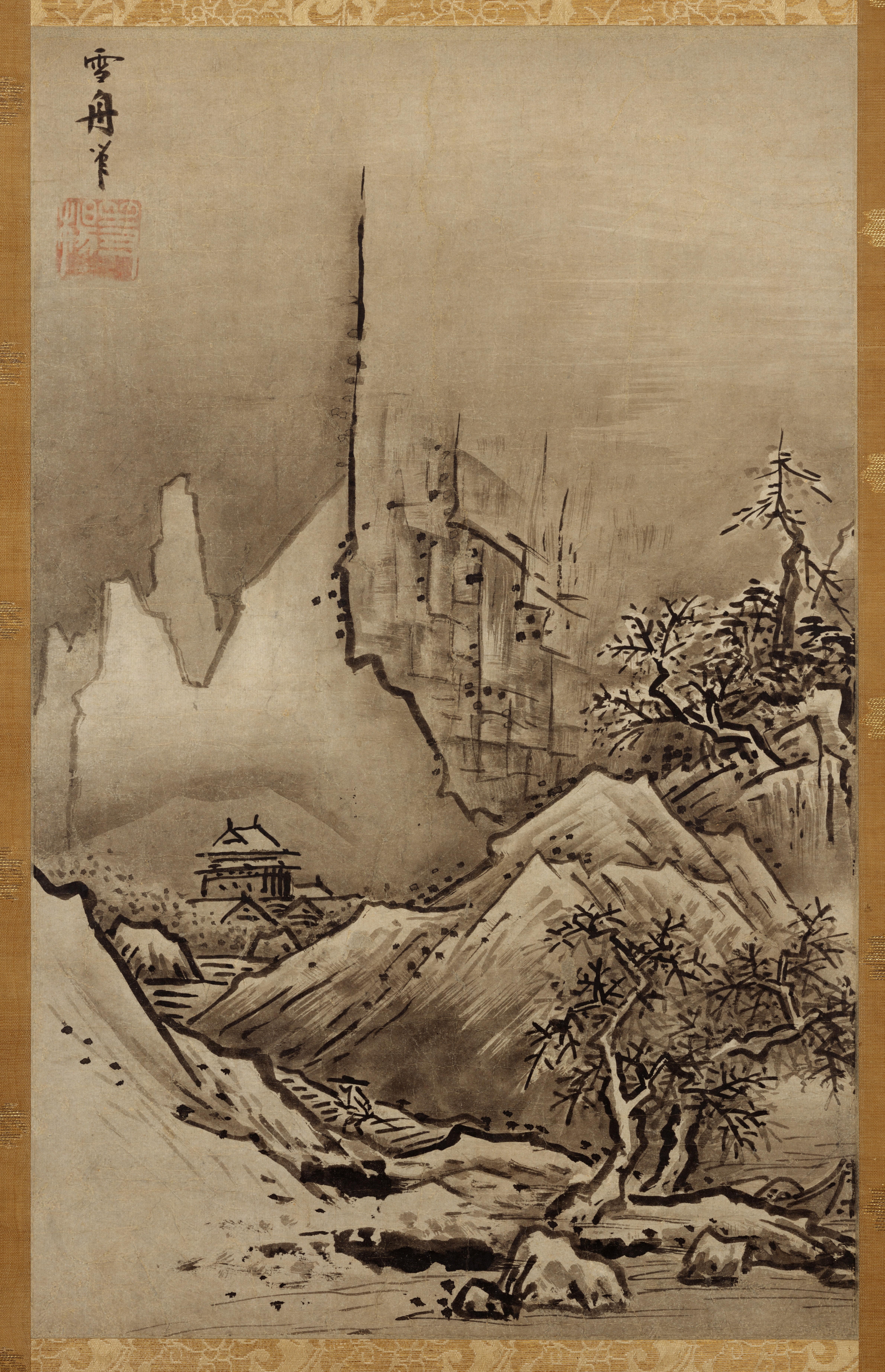
A painting by sumi-e master Sesshu
Tools
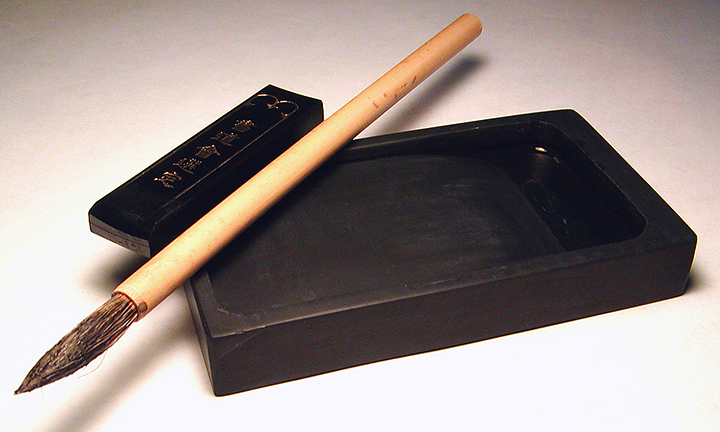
Sumi-e requires four different tools. The preparation and use of each has its own process and meditation. These tools are the ink (sumi), the ink stone (suzuri), the brush (fude), and the material to be painted on, usually paper (washi) or silk
The Sumi
Sumi is generally produced out of pine or bamboo ash and a binding agent made from fish bones. In order for sumi to properly set in its molded form, humidity and temperature must be just right. For this reason, the highest quality ink blocks are only produced between October and May. To get an even better ink, artisans will often allow a block to age for several years before selling or using it.
A Sumi Block (left), Fude (middle), and Suzuri (right)
As per the Zen way, when an artist uses an ink block, they should consider the amount of time and hard work that went in to its production. Having this connection to the ink gives it a sense of being precious, and adds to the delicacy required for each stroke.
Although sumi ink it typically described as monochromatic, this does not necessarily mean just black and white. It is often produced in four common colors: black-black and brown-black, both of which are used mostly for rocky landscapes and winter scenes, as well as black-blue and black-purple, which are generally used for spring scenes.
The Suzuri
The Suzuri is a delicately carved piece of slate used to create the ink produced from a sumi block. It is considered the focal point of the meditative process that is creating a sumi ink wash. As with the sumi block, it takes a master artisan to produce a quality suzuri.
After adding a few drop of water, the artists rubs a sumi block against the stone until an ink of the desired consistency has been produced. As mentioned earlier, this is all done with a great deal of focus, tapping in to the present moment. It is an embodiment of Zen philosophy.
The Fude
A quality sumi brush is made from natural materials and furs (often goat, rabbit, ox, and deer). The material used is chosen based on the desired stroke look, size, absorbency, and stiffness of the brush.
The Washi
Besides the materials of the brush, the manner in which washi is created determines how the brush strokes will appear. This paper can be made out of either plant fibers or rice. Sometimes washi is also treated with a glue in order to prevent the ink from absorbing and spreading into the paper.
Painting and Sword Work
Because of the precision and meditation required to create ink wash paintings, the practice rose to such a level of esteem that it was seen to embody the standards of Bushido. The one mindedness of a brush master was seen as a comparable state as that of a composed warrior on the battlefield. As one writer put it, “for the swordsman, composure on the brink of battle had its artistic parallel in the calm and tranquility essential before the fearless release of a brush stroke.”
ar
Famous Artists:
Sesshu: Sesshu is considered on of the greatest sumi-e artists of all time. Living during the Muromachi period, Sesshu traveled to the home of ink wash, China, in order to gain a better understanding of the art. He took what he learned and transformed it in to a style that was uniquely Japanese.
Miyamoto Muasashi: Muasashi lived during the edo period. Not only is he know for his artistic prowess, but also his skill in swordsmanship (he is often called kensai: “sword saint”) and for inventing a style of two-sword dualing.
Sesson Shukei: This 16th century artist was a self-taught monk who lived in northern Honshu. He is known for his bold brush strokes in landscapes.


Comments (0)
You don't have permission to comment on this page.